
Every so often the numbers behind a weather record turn out to be more interesting than the record itself. Temperature is exactly that case: the official hottest reading on Earth is now seriously disputed by the scientists who study it, the official coldest reading has effectively been beaten by an instrument that doesn't officially count, and the fastest recorded temperature swing happened in about the time it takes to read this sentence.
The hottest temperature ever recorded, and why it might be wrong
The official record stands at 56.7°C (134°F), measured at Greenland Ranch, in what's now called Furnace Creek, Death Valley, California, on 10 July 1913. It has held that status since 2012, when the World Meteorological Organization struck down an even higher reading, 58°C at Al Azizia, Libya in 1922, after an investigation found the measurement invalid. Death Valley's 1913 figure became the record by default.
The trouble is, a growing body of research thinks the Death Valley reading is wrong too. A study published in the Bulletin of the American Meteorological Society in 2026 compared the Death Valley station's historical readings against more than a century of data from nearby higher-elevation stations and concluded the 1913 figure was likely around 14°F, roughly 7-8°C, hotter than what actually occurred that day. The lead researcher, a climatologist who has studied the Death Valley record for over 30 years, has said he's close to certain the measurement wasn't valid. It's a serious enough case that it's now under review by the official body responsible for climate extremes.
If the 1913 reading is eventually struck from the books, there isn't really a clean second-place figure to fall back on. The next-highest reliably measured temperatures at Death Valley itself are a trio of 130°F readings from 2020, 2021 and 2024, and 129.2°F, matched independently at Death Valley in 2013 and at Mitribah, Kuwait in 2016. For now, though, the 1913 figure remains the official record while the review plays out, a reminder that even a century-old record can still be actively contested.
The coldest temperature ever recorded, and the one that doesn't quite count
The coldest air temperature ever measured by a physical weather station is −89.2°C (−128.6°F), recorded at Russia's Vostok Station in Antarctica on 21 July 1983, roughly 54°C colder than the average winter temperature there. Vostok sits deep in the interior of the East Antarctic ice sheet, one of the most isolated and hostile research outposts on the planet.
That reading has effectively been beaten, just not by a thermometer. Starting in 2013, researchers at the University of Colorado's National Snow and Ice Data Center analysed over a decade of satellite data across the East Antarctic Plateau and found surface temperatures dropping as low as −98°C (−144°F) in shallow topographic depressions on a high ridge between two summits known as Dome Argus and Dome Fuji, places colder still than Vostok itself because they sit higher on the ice sheet. The catch is that satellite-derived surface temperatures and a physical thermometer aren't measuring quite the same thing, and it's difficult to know precisely what height above the ground the satellite reading actually represents. Because of that, the −98°C figure isn't officially recognised as the record, even though it's unambiguously the coldest temperature ever detected on Earth's surface by any method. Researchers involved in the discovery believe it's close to the physical limit of how cold the surface can get anywhere on the planet, requiring days of perfectly clear skies and calm air to reach.
The fastest temperature change ever recorded
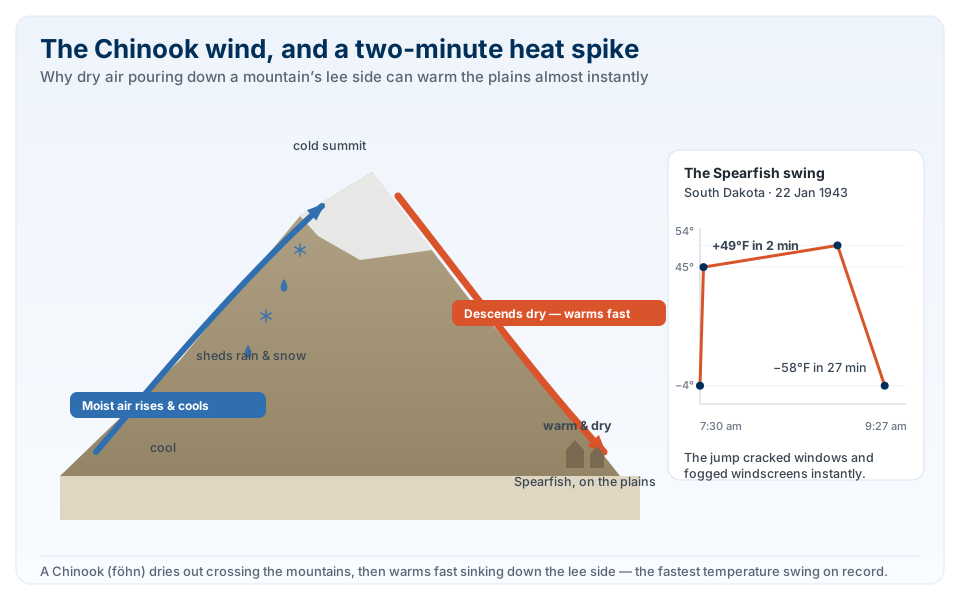
Of the three records here, this one has the strangest story. On the morning of 22 January 1943, the small town of Spearfish, South Dakota, was sitting at a bitterly cold −4°F at 7:30am. A Chinook wind, the same kind of warm, dry downslope wind that regularly hits the eastern side of mountain ranges, began blowing in off the Black Hills. Two minutes later, at 7:32am, the temperature had jumped to 45°F, a rise of 49°F in 120 seconds. It kept climbing, reaching 54°F by 9am. Then, as the Chinook died down, the reverse happened: the temperature fell 58°F back to −4°F in just 27 minutes.
The swing happened fast enough to physically crack glass windows and instantly fog car windscreens. It remains, by a wide margin, the fastest temperature change ever officially recorded anywhere on Earth, and the original event was significant enough to appear in that period's National Weather Bureau records, describing multiple sharp swings across the same morning as an unusually intense airmass boundary sat almost stationary over the region. Chinook winds happen because moist air is forced up and over a mountain range, cooling and dropping its moisture on the windward side, then descends the leeward side as dry air that warms rapidly as it loses elevation, exactly the setup that sits east of the Black Hills. What made January 1943 exceptional wasn't the mechanism, which is a routine feature of the region's weather. It was the combination of an unusually cold airmass sitting right at the boundary with an unusually strong Chinook, producing a change so extreme it's never been matched since.